
 English
 Uzbek
Uzbek
 Russian



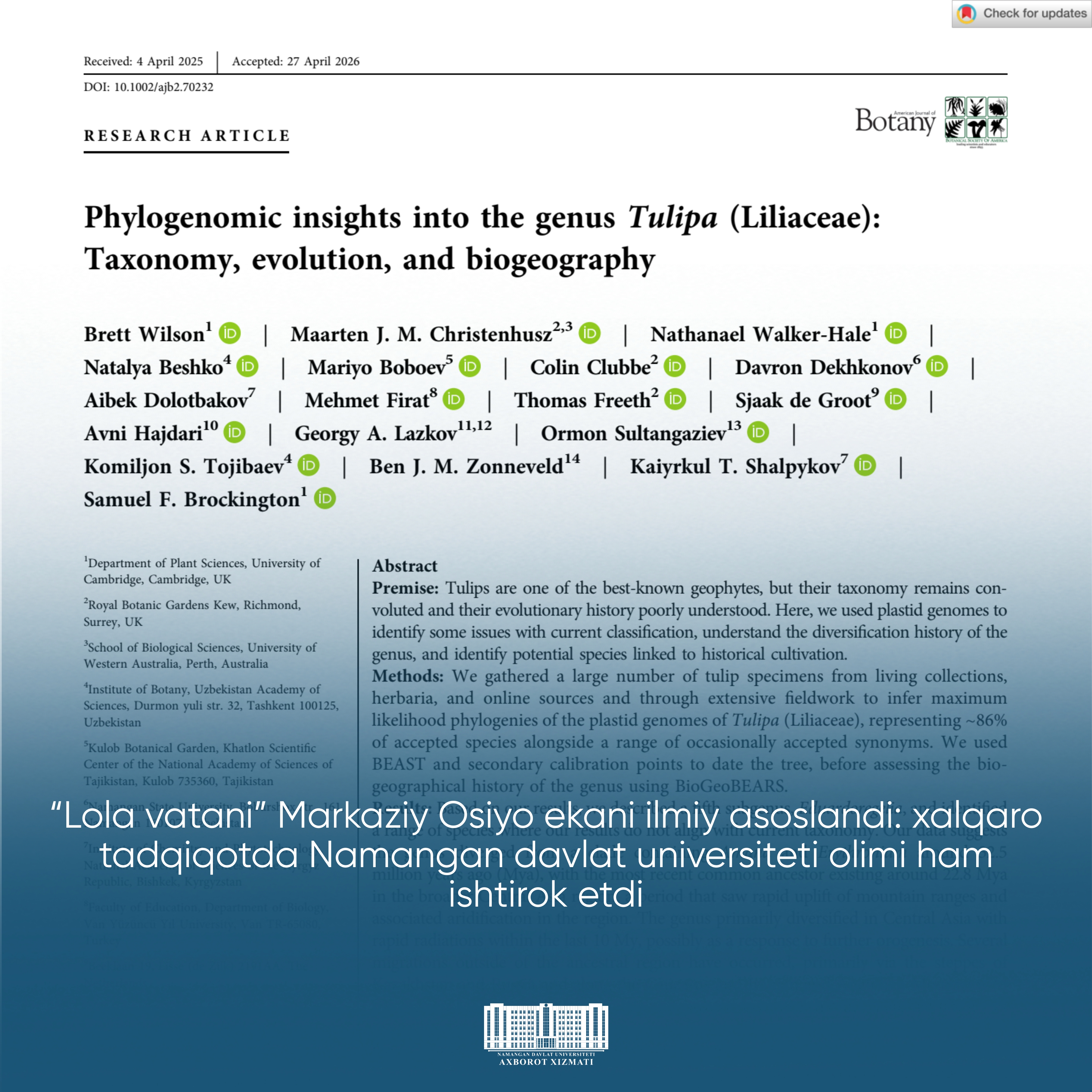
A new international study published in one of the world's prestigious scientific journals, the American Journal of Botany (AJB), has provided scientific evidence that Central Asia is the principal center of origin and evolutionary development of tulips.
The fundamental study was conducted by an international research team comprising scientists from the Institute of Botany of the Academy of Sciences of Uzbekistan, specialists from the University of Cambridge, and the Royal Botanic Gardens, Kew, United Kingdom. Davron Dehqonov, a botanist at Namangan State University, actively participated in the study as a member of the international research team.
The research represents another significant scientific achievement involving representatives of the botanical scientific school established by Academician Komiljon Tojiboyev. Using extensive genetic data, the international team reconstructed the evolutionary history of the genus Tulipa. The researchers analyzed 254 plastid genomes, covering approximately 86 percent of the known diversity of tulips.
The resulting genetic phylogeny made it possible to trace the history of tulips over millions of years. According to the study, the Tulipa lineage diverged from its closest relatives approximately 32.5 million years ago, while the common ancestor of modern tulips emerged later, around 22.8 million years ago. Biogeographic analyses identify Central Asia as its region of origin.
Thus, Central Asia is not merely one of the regions where tulips are distributed; it is also a key region in their early evolution and subsequent diversification. The researchers note that the mountains of Central Asia can now be referred to with greater scientific confidence as the “homeland of tulips.”
The study also helped refine the classification of tulips. DNA analyses confirmed the independence of several species, while a separate subgenus, Eduardoregelia, was established for Tulipa heterophylla. In addition, genetic data confirmed the independent status of Tulipa affinis, a species found in Kyrgyzstan, Tajikistan, and Uzbekistan.
The findings are important not only for addressing fundamental questions in botanical science but also for assessing the status of wild tulip species in Central Asia, strengthening their conservation, and updating the national Red Data Books of the countries of the region.
Of particular significance is the active participation of Davron Dehqonov, a botanist at Namangan State University, as a member of the international research team behind this major scientific study. His participation reflects the growing scientific capacity of Uzbekistan's higher education institutions and their increasing engagement in international scientific cooperation.