 English
 Uzbek
Uzbek
 Russian



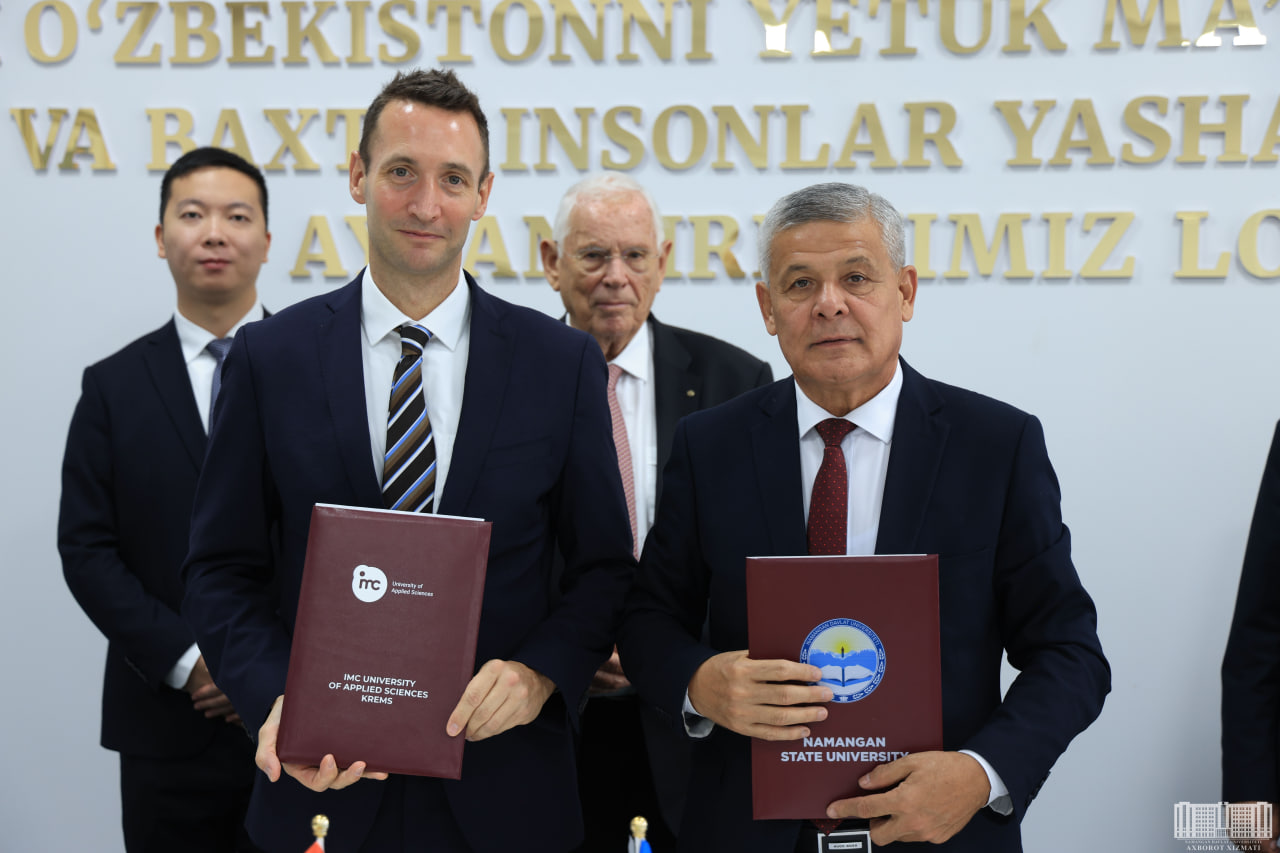
A delegation from one of Austria’s leading higher education institutions — IMC Krems University of Applied Sciences — paid an official visit to Namangan State University.
The rector of Namangan State University, Abdug‘affor Qirg‘izboyev, warmly welcomed Professor Heinz Boyer, Chairman of the Supervisory Board of IMC Krems University of Applied Sciences, Udo Brendle, Chief Executive Director, and Chen Yang, Head of the Department for International Affairs.
During the meeting, Rector Abdug‘affor Qirg‘izboyev familiarized the guests with the university’s initiatives in the field of international cooperation, as well as the opportunities and conditions created for students at Namangan State University.
IMC Krems University of Applied Sciences, founded in 1994 and located in Vienna, currently has about 3,100 students and 560 professors and teaching staff. The university maintains partnerships with nearly 200 international institutions and holds several quality management certifications from European and international accreditation agencies, including ISO 9001, ISO 14001, and ISO 29990. IMC Krems also runs joint educational programs with universities in Azerbaijan, China, Egypt, Saudi Arabia, and Uzbekistan (Tashkent State University of Economics).
During the meeting, Professor Heinz Boyer shared his impressions, stating:
“This is my first visit to Namangan. The Land of Flowers has left a deep impression on me. We are planning a major project in the region that will integrate tourism, hospitality, and education. It will be based on the dual education model, and I am confident that our cooperation will serve as a bridge between Namangan and Europe in the future.”
As part of the visit, a bilateral meeting was held between the two universities. The parties discussed the establishment of a joint educational program in tourism and hospitality and the prospect of opening a joint faculty in the near future.
During the negotiations, both sides emphasized that strengthening educational ties between Uzbekistan and Austria is of great importance in preparing young people from both countries for the new stages of global tourism development. The discussions also covered topics such as faculty exchange, participation in international grant projects, and expanding scientific research cooperation.
At the conclusion of the talks, the parties signed a Memorandum of Understanding, outlining collaboration in several key areas, including student exchange, joint research and academic programs, faculty and researcher exchange, publication and sharing of scientific materials of mutual interest, organization of internship programs for students and graduates, and the development of joint media and information resources.
This memorandum marks a new stage of cooperation between the two higher education institutions, laying a solid foundation for partnership in the fields of education, science, and tourism.